
I recently bought a subscription to the British Newspaper Archive (BNA) – a project run in partnership by the British Library and findmypast. The archive’s aim is to digitise up to 40 million newspaper pages in the British Library’s archives over a ten-year period.
It feels like I’ve reached the limits of what free online research can provide in terms of valuable information. Running short on leads and feeling in need of some new direction, I decided to stump up for the modest subscription fee and delve into the BNA ‘s archives to see what I could find.
The answer to that is – a lot! So much so that I’ve only really scratched the surface after several hours of poring through search results. Nonetheless my research thus far has produced some interesting results which I will go on to describe.
Starting Small
The challenge with having access to such a massive repository of data is that it can be tricky to find exactly what you need. In that regard, Wittering introduces a couple of specific issues:
- Shared Place Names: As I’ve explained in my What’s In A Name article, Wittering isn’t the only place in England to be so-called. It shares the honour with The Witterings, both East and West, of West Sussex. While their etymologies are different their contemporary spellings are identical. This obviously introduces some big issues when attempting to search by place name.
- People Names: Wittering is also a surname. While uncommon, when dealing with search results numbering in the thousands, these results further crowd out valuable results.
Deciding to leave this battle to be fought another day, I changed tack and considered ways to narrow my search results. I knew that Whittering was an alternative spelling for the village in the past, so attempted a search for this.
With regards to the points above, Whittering is a unique place name in the UK and a less common surname, so my search results would be considerably less crowded. With Whittering being an defunct name in recent decades, my results should also be geared towards the past.
The result – a tidy 1,261 results compared to the more than 40 thousand when searching for ‘Wittering’! With a manageable pool of articles I was ready to begin digesting my results.
The Breakdown
The BNA helpfully breaks down results by country, region, publication name, date and type. Studying these numbers quickly makes some things apparent.
Date Distribution
| Date Range | Number of Articles |
|---|---|
| 1750-1799 | 27 |
| 1800-1849 | 316 |
| 1850-1899 | 744 |
| 1900-1949 | 131 |
| 1950-1999 | 36 |
| 2000-2020 | 7 |
This is a fairly normal distribution of articles with an outright majority being published in the latter 19th century with gradual decreases further back in time and similarly ahead into the future.
However clear the trend appears it’s important not to make too many assumptions. The availability of newspapers in the British Library’s archive needs to be considered. It’s possible there are fewer articles available as one moves further back in time as copies of older issues would naturally become more scarce.
Articles can be manually transcribed and corrected by users of the BNA, but by default text is machine-read. Older newspaper issues may be more difficult for computer software to read, meaning words aren’t properly indexed and searches for certain keywords won’t return results even though these words may be present in scanned pages.
In summary, it’s important not to draw too many assumptions from these numbers!
Newspaper Distribution
| Newspaper | Number of Articles |
|---|---|
| Stamford Mercury | 400 |
| Northampton Mercury | 218 |
| Lincolnshire Chronicle | 66 |
| Grantham Journal | 26 |
| Cambridge Chronicle and Journal | 16 |
| Leicester Chronicle | 15 |
This doesn’t come as much of a surprise, but articles appeared most frequently in newspapers published in closest proximity to the village. Stamford only lies a matter of several miles from Wittering, which explains why the lion’s share of articles come from the town’s Stamford Mercury newspaper. Modern day Wittering lies in the county of Cambridgeshire, but for many years laid within Northamptonshire, which explains why the village was mentioned in the Northampton Mercury 218 times. The village also lies in close proximity to the county of Lincolnshire, which explains why the Lincolnshire Chronicle references Wittering 66 times.
Making Sense
Having spent many hours in the past trawling through out-of-print books in search of mentions of Wittering no matter how tangential, I was now presented with many hundreds of incredibly specific results that zeroed in on this place. I spent the coming weeks gradually poring through these articles, saving the ones worthy of record.
Once I had finished reading through the complete search results I was left with a collection of roughly 200 articles. I decided to tabulate the results (accessible here) to create a more accessible reference. For each article I recorded the date, publication, the type of article (for example: obituary, classified ad, news article, etc.), the approximate subject of the article, the names of people of particular relevance in the article, and a brief written summary of the article.
| Article Type | Number of Articles |
|---|---|
| Classified Ad | 69 |
| News (Crime) | 24 |
| News (Agriculture) | 12 |
| News (Church) | 21 |
| News (School) | 5 |
| News (Other) | 30 |
| Obituaries | 13 |
| Other | 29 |
Of 203 articles, the largest proportion were, perhaps unsurprisingly, news articles, forming nearly half of all results (93 articles). I decided to categorise these results further as many of these articles touched on similar topics including the church, the school, agriculture and crime. Anything else which didn’t fit into these four categories falls into the News (Other) category.
The next largest proportion were classified ads (69), advertising a range of commodities including livestock, farming implements, property, crops and a range of job vacancies including work for labourers, maidservants, farm hands, wagon drivers, and more.
There were 13 obituaries and 29 other articles which were too varied in scope to allow for further helpful categorisation but which touched on a range of subjects including summaries of the meetings of local societies, population data, receiving orders, removal orders, and sport results.
Building An Image
Exactly how much can a single article, or particular type of article, tell us about Wittering? Classified Ads, News Articles and other smaller articles including Obituaries are helpful in different ways, but can all provide helpful information.
Classified Ads
Let me present an example – a simple classified ad found in the Derby Mercury:
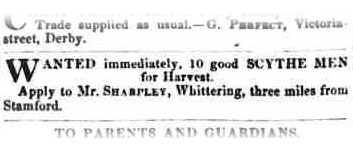
Image © THE BRITISH LIBRARY BOARD. ALL RIGHTS RESERVED.
There’s not a lot going on in this clipping, but we can try to draw some assumptions from just these few words. The ad asks for applications to be made to a Mr. Sharpley of Whittering. We can’t be certain, but there’s a possibility this Sharpley would be the employer of these scythe men. If true, Sharpley would be a landowner in the village. Advertising vacancies for ten scythe men not only suggests a large tract of land needs to be harvested, but also that the employer possesses the financial means to employ ten people.
Here’s another example – an advertisement promoting the wares and services of William Baker’s Wine Vaults on Red Lion Street in Stamford:
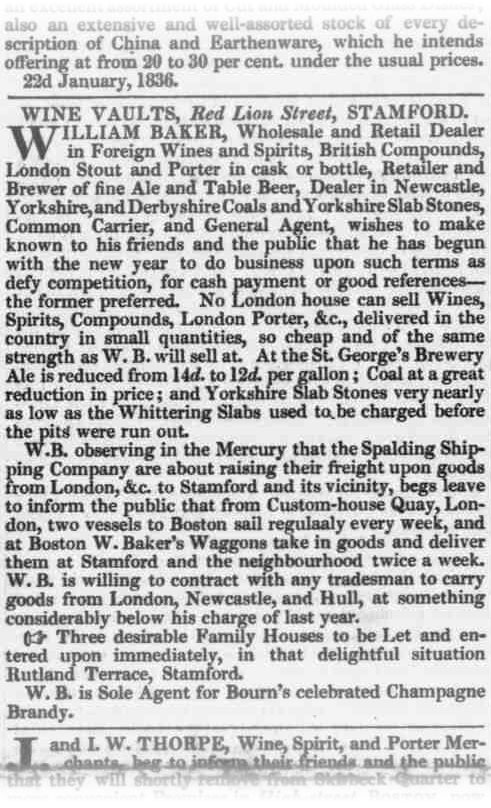
Image © THE BRITISH LIBRARY BOARD. ALL RIGHTS RESERVED.
Much of this clipping is of no relevance to us, but there’s the briefest of references to ‘Whittering Slabs’ at the end of the first paragraph. Previous research has told me there may have been quarries in Wittering, so this advertisement could be giving us some important clues as to when exactly the quarries were in operation (the advertisement mentions that the pits have already been run out, so quarrying must have taken place up to or before 1836) and the commercial value of the stone being quarried.
Let’s look at one last classified ad. This one is an advertisement for the tendering of restoration works on Whittering Church:
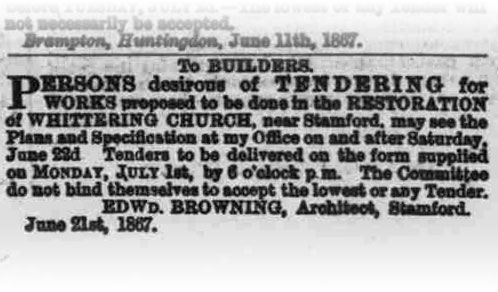
Image © THE BRITISH LIBRARY BOARD. ALL RIGHTS RESERVED.
Already knowing that a lightning strike caused considerable damage to the church in 1866*, this brief advertisement gives a glimpse into the process of restoration. From the clipping we can assume that the restoration work was undertaken by the architect Edward Browning of Stamford. As it happens, Browning was a prolific architect in the region, responsible for the design or restoration of several notable building in the area.† A later article of April 1869 announces that Browning’s plans and specifications for the restoration work were now available to view. News articles from the following year give further updates on the restoration work. In all, newspaper articles give a valuable account of church restoration as it happened, giving an indication of the scale of work and the timescales involved.
News Articles
General news articles are one of the most straightforward ways of gathering information about Wittering. With that said, the scope of news relating to the village is so wide that I won’t attempt to cover it all in this post. In order to maintain some level of focus I decided that the important thing was to establish trends. Was there a general theme to the stories being reported? What was being reported, and what was considered ‘newsworthy’ in the context of this village?
Readership is another consideration. It’s important to remember news wasn’t necessarily being reported for the sake of the residents of Wittering. While local newspapers such as the Stamford Mercury would report on local issues for the local area, there would probably be many aspects of everyday village life that would be considered too mundane to be offered regular column inches. It’s possible only the more dramatic happenings of the village were being reported, so we should bear in mind that these stories are kept in context rather than assuming they formed the meat and bones of everyday life!
Agrarian Life
Collating these stories, it was impossible to avoid the way farming pervaded life in Wittering. The vast majority of classified ads found during my search related to agriculture in some way, whether this was the sale or auction of farming property, livestock, tools or crops for grazing, or the recruitment of farmhands. There were so many that I won’t bother listing every example, but these advertisements were ever-present in the scope of my search results, from the late 18th to early 20th century.
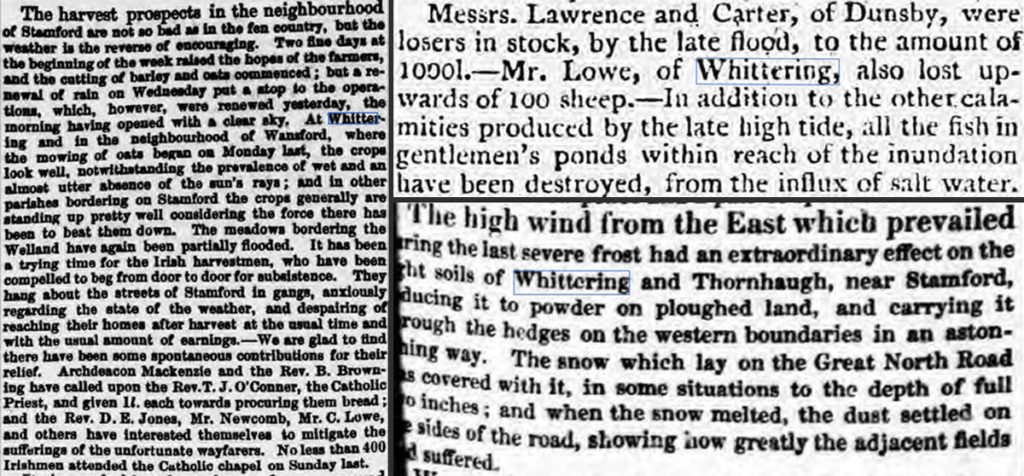
The hardships of farming life through challenging conditions were considered worthy of reporting. See the few examples below.
All Images © THE BRITISH LIBRARY BOARD. ALL RIGHTS RESERVED.
The article in the Stamford Mercury from 1860 describes the poor prospects for that year’s harvest, with knock-on effects on the Irish migrant labourers who would typically work on fields in the region. Meanwhile, inclement weather in preceding decades had a noteworthy impact on the condition of farming land and livestock, with Mr. Lowe of Wittering losing over 100 sheep to high tide flooding in December 1810.
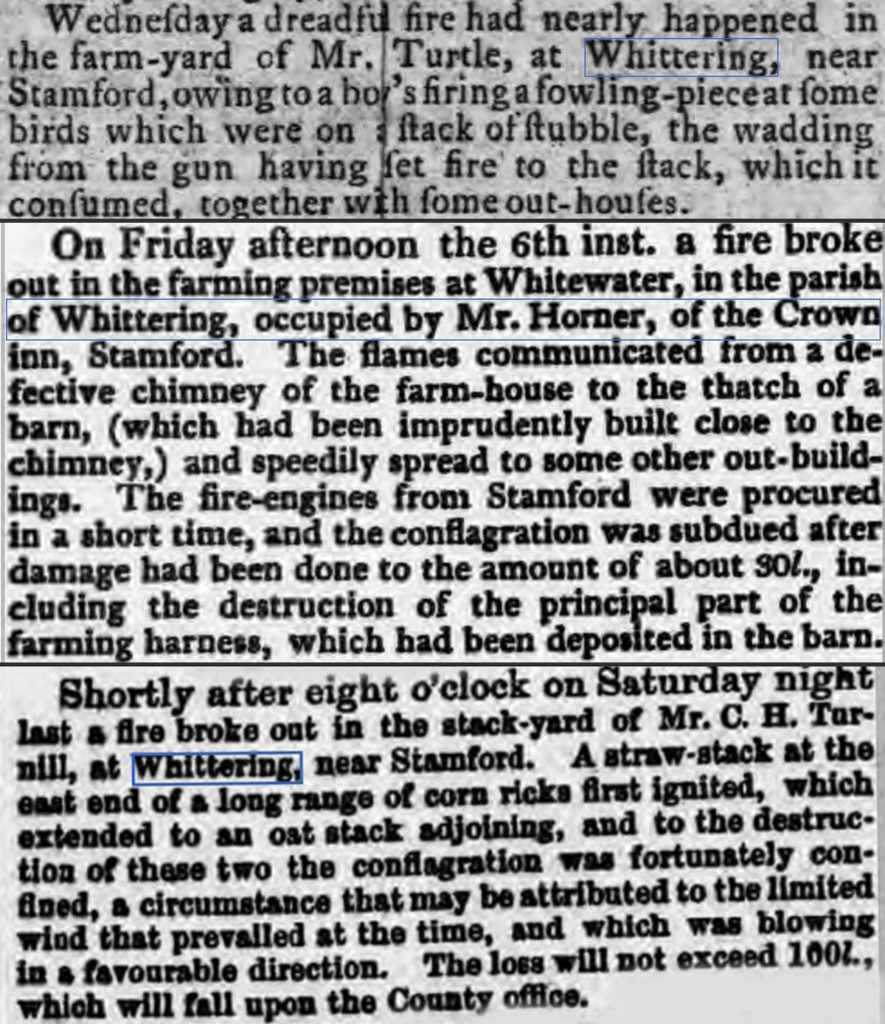
All Images © THE BRITISH LIBRARY BOARD. ALL RIGHTS RESERVED.
Above are three examples of fires occurring on farmland in Wittering. In an age without motorised travel and speedy response from emergency services the risk of fire causing substantial damage to farm property was substantial. The damage from the final example was estimated to cost £160, almost £20,000 in present day when adjusted for inflation‡.
Newspapers regularly listed the results of the many agricultural competitions that would occur through the year. Activities ranged from grass mowing, to sheep shearing, to ploughing meets.
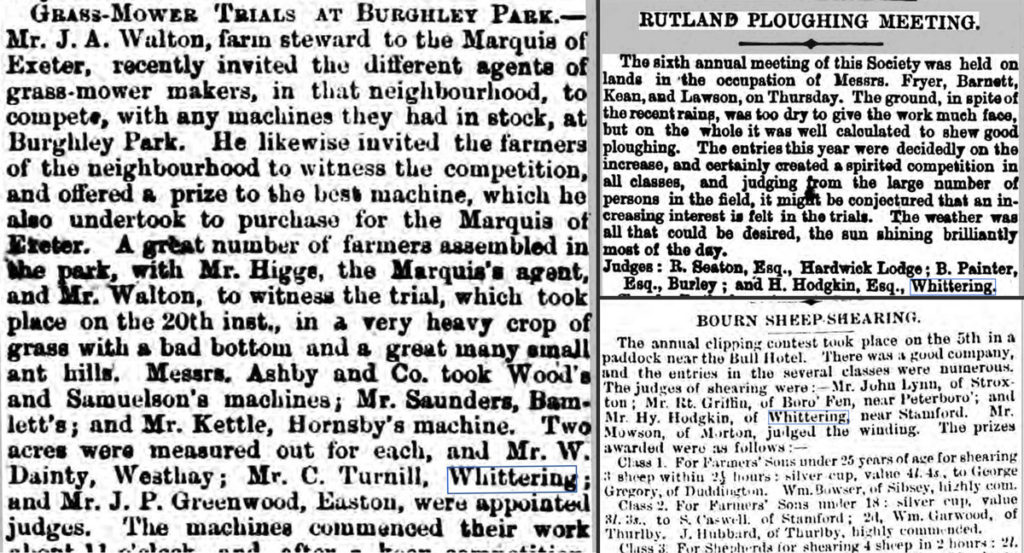
All Images © THE BRITISH LIBRARY BOARD. ALL RIGHTS RESERVED.
Farmers from Wittering including Mr. Turnill and Mr. Hodgkin appeared as judges at these competitions, highlighting their skill, expertise and good standing in the local community.
Even the most seemingly mundane farming matters found their way into newspapers, as the two following examples show.
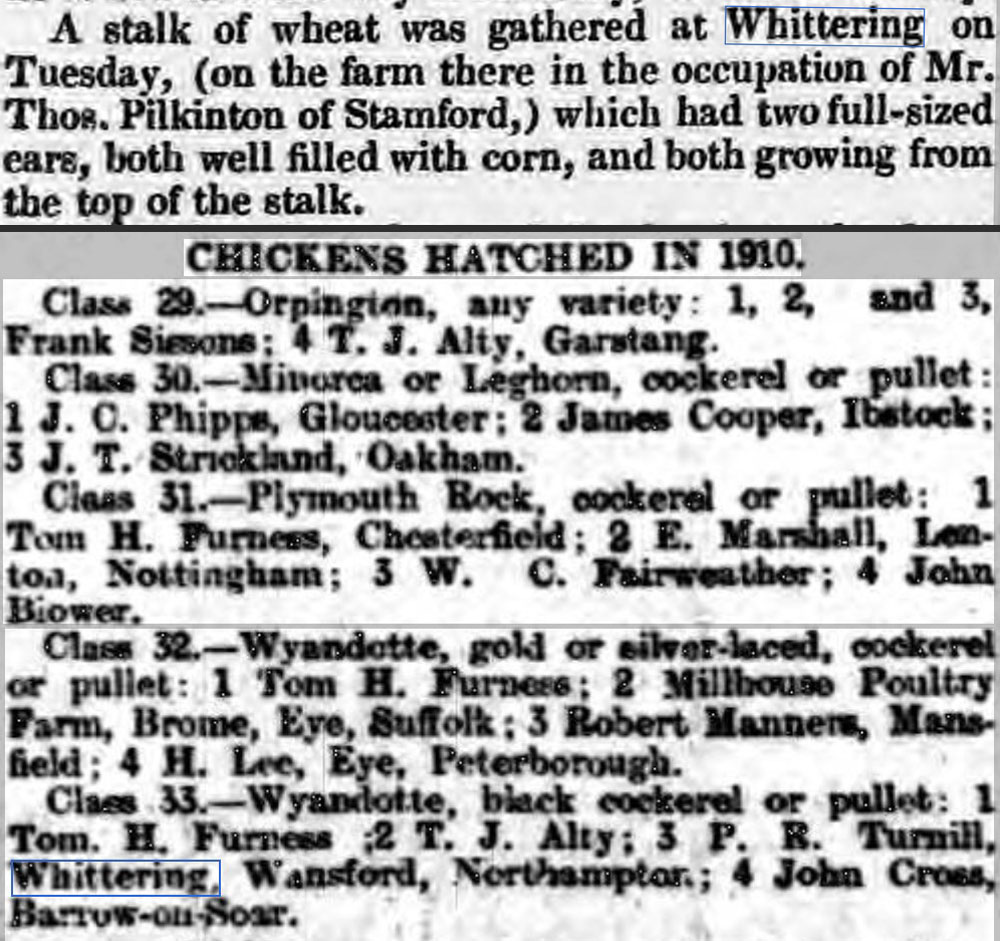
All Images © THE BRITISH LIBRARY BOARD. ALL RIGHTS RESERVED.
The first is a curious example of what may be considered noteworthy in this time, a stalk of wheat with two full-sized ears of corn growing from the top of the stalk. Perhaps it was a slow news week, but this may have been indication of a good coming harvest. The importance of the second clipping isn’t certain, but clearly the hatching of new chickens was considered of sufficient importantce to the local community to be reported.
The Great North Road
Wittering’s placement alongside the historic Great North Road (present-day A1 road) brought with it various stories of road accidents, robberies and challenging weather conditions.
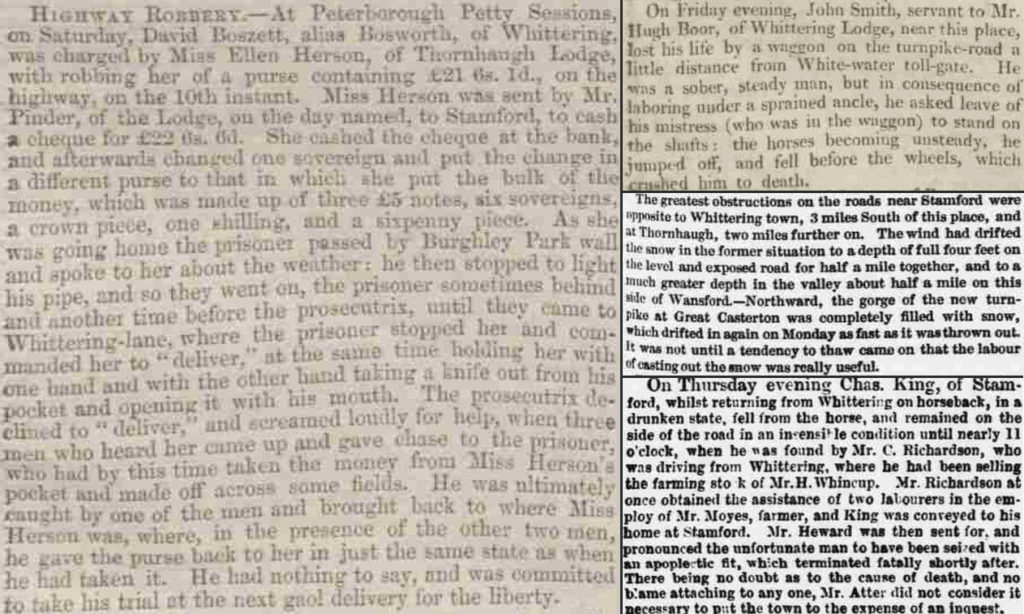
All Images © THE BRITISH LIBRARY BOARD. ALL RIGHTS RESERVED.
Matters of Crime
By looking at the nature of crimes committed, for example the type of crime, the value of goods stolen, and makeup of the perpetrators, we can attempt to steal a glimpse into life in Wittering.
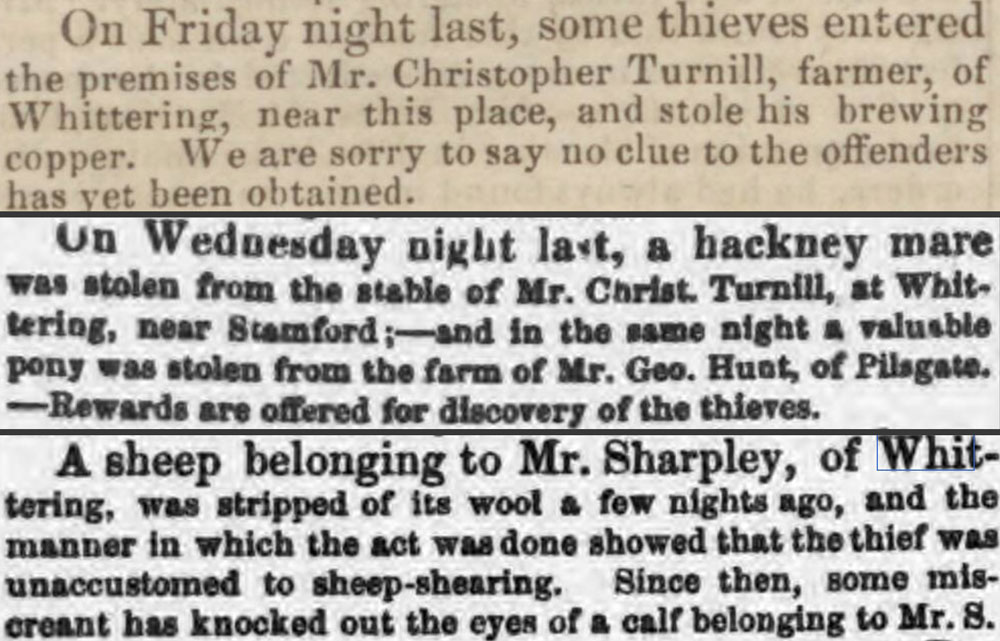
Let’s take thefts as our first example. For someone to fall victim to a theft would suggest they have something worth stealing, potentially giving an indication of who the wealthier residents in the village were.
All Images © THE BRITISH LIBRARY BOARD. ALL RIGHTS RESERVED.
A few examples of some typical crime stories are above. The name Sharpley, which we had seen when looking at classified ads, reappears along with a new name, Christopher Turnill, who is described as a farmer in the village. In the first instance, Turnill falls victim to a theft of brewing equipment. A few years later he has a hackney horse stolen from his stables. Meanwhile Sharpley has a sheep stripped of its wool and a calf physically abused. Another story not listed above involved the theft of fowls from a Mr. Baker in April 1859. A Mrs. Baker appears some 60 years previous whose house was broken into, having various furniture and items of clothing stolen in December of 1800. Whether these two Bakers are related isn’t known.
Reports of poaching in Wittering appeared several times throughout the 19th century. The Marquis of Exeter was the principle landowner in the region. As such, had the power to impose game laws on lands under his ownership. The clipping below is from 1807, and serves as a caution to anyone looking to ‘do sport’ within the listed lands, including Wittering.
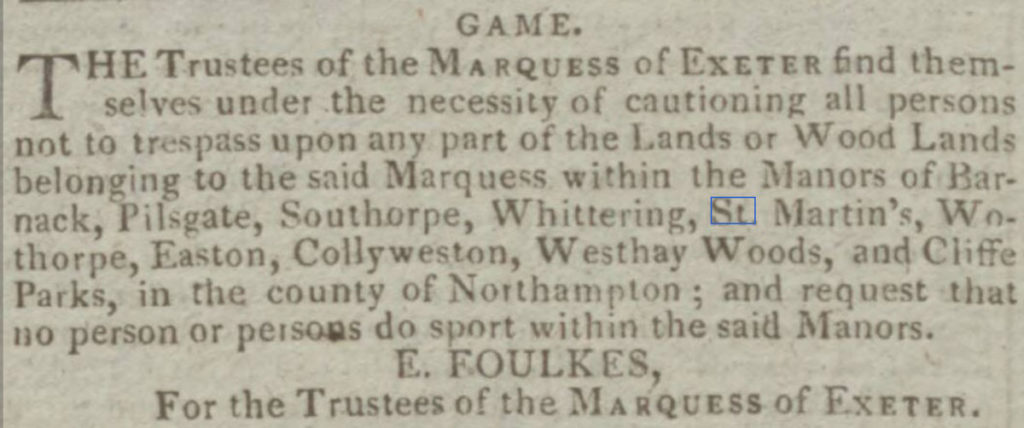
Image © THE BRITISH LIBRARY BOARD. ALL RIGHTS RESERVED
Another article from 1811 in the Stamford Mercury lists persons who had obtained ‘game certificates’ for the price of either one or three guineas, which presumably gave those certificate holders the permission to hunt in certain lands.
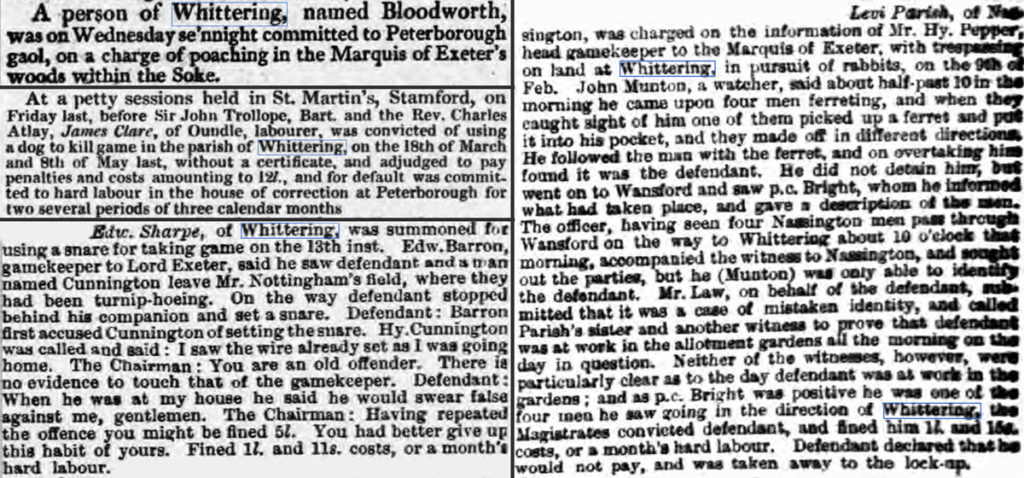
There were however many hunting without such paid permission. The clippings below are a sample of the many prosecutions for game law violations in the Wittering area.
All Images © THE BRITISH LIBRARY BOARD. ALL RIGHTS RESERVED.
Community Events
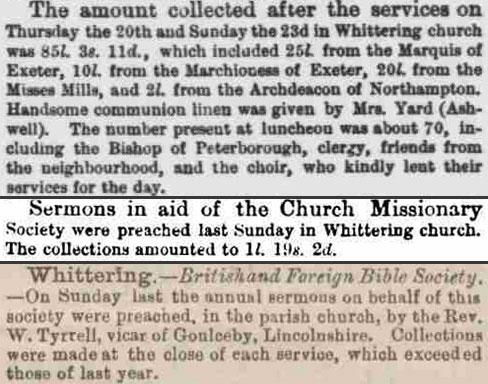
A glimpse was offered into the nature of past gatherings and festivities in the village.
All Images © THE BRITISH LIBRARY BOARD. ALL RIGHTS RESERVED.
These clippings show that the church was at the very least the host of semi-regular meetings for services and sermons. How regular these meetings were exactly is an as-yet-unanswered question. The totals of church collections are also mentioned – were these significant, and could they be used as a measure of affluence or generosity in the village? Perhaps if collections were studied in neighbouring villages of a similar size these numbers could be gauged to that end.
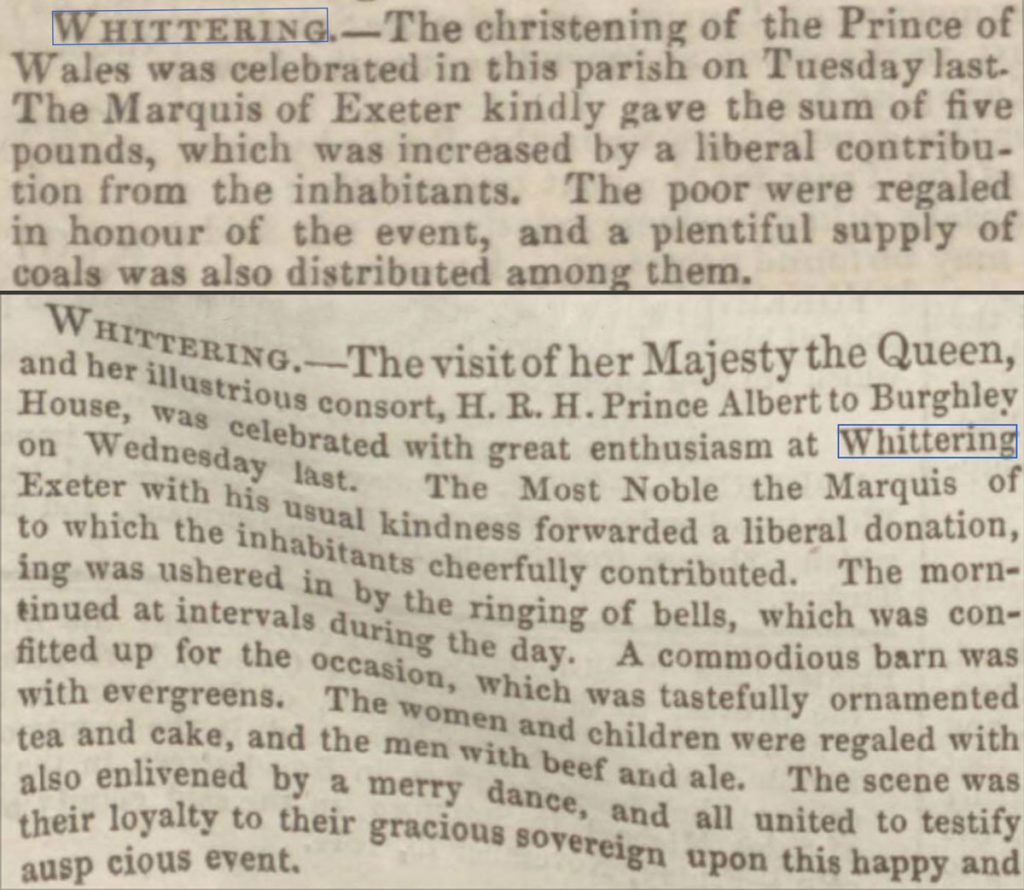
All Images © THE BRITISH LIBRARY BOARD. ALL RIGHTS RESERVED.
Royal occasions were a cause for celebration in the village. The two clippings above, from two years apart, detail the celebration of the christening of the Prince of Wales in 1842 and the visit of Queen Victoria and Prince Albert to Burghley House in 1844 respectively. On each occasion the Marquis of Exeter made a donation to the parish, with further contributions from inhabitants of the village. In the case of the former occasion it seems the donations were used to make an offering to the local poor.
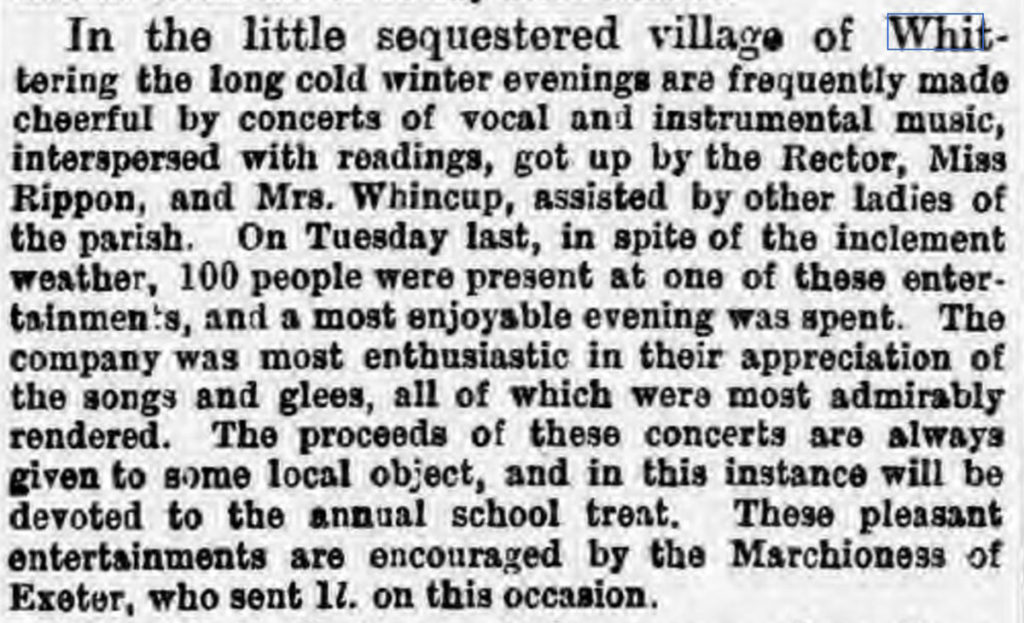
Image © THE BRITISH LIBRARY BOARD. ALL RIGHTS RESERVED.
Finally, we have this article from February 1881, which describes regular winter concerts organised by the Rector, Miss Rippon (then the school headmistress) and Mrs. Whincup (wife of farmer Henry Whincup). It isn’t clear where the concerts are hosted, but around a hundred people were pleasant at this particular event despite poor weather. The concerts were also a fundraising opportunity and were in turn encouraged by the Marchioness of Exeter.
Other Articles
Outside of classified ads and run-of-the-mill news articles, there are other forms of information which can help us learn more about Wittering. There isn’t as much meat on the bones of these smaller pieces, yet they’re still able to offer something of value.
Marriages and Obituaries
One of the most straightforward sources of information, marriages and obituaries are a useful record for who resides or resided in the village at a given time. The length of an announcement may be an indicator of the deceased’s wealth or standing in the community.
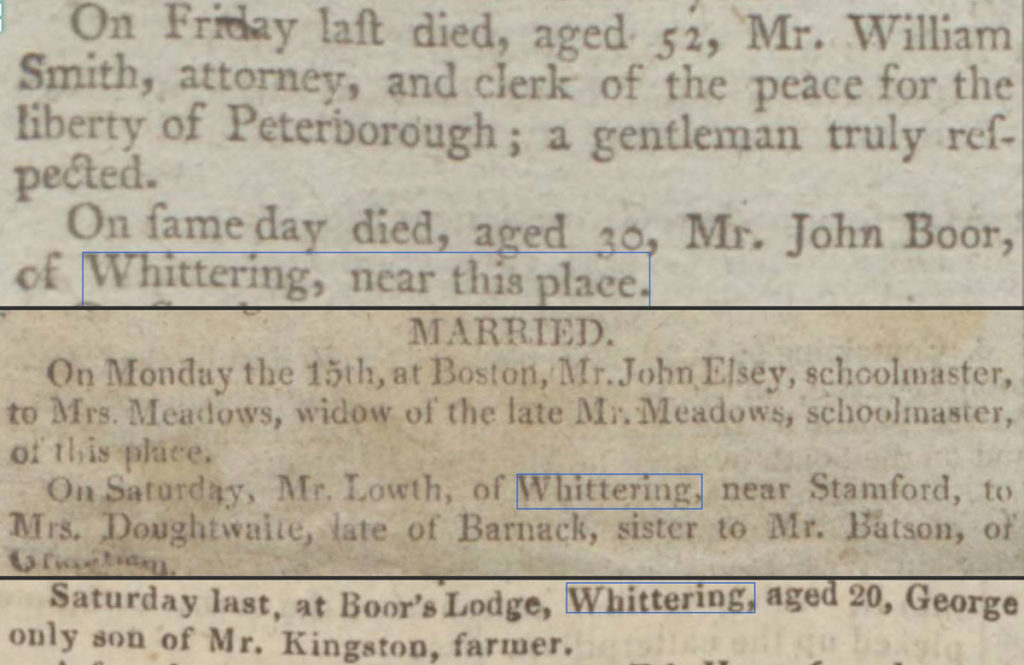
Huntingdon, Bedford & Peterborough Gazette, Saturday 19 September 1835.
Image © THE BRITISH LIBRARY BOARD. ALL RIGHTS RESERVED.
Data Tables
Occasionally data tables are published giving information such as census data and school funding figures. There isn’t much to say about these articles, but they are clearly useful as a raw, ready source of information without anything in the way of forensic deconstruction or analysis.
Conclusions
Newspapers are an valuable window into life in Wittering, helping us to learn more about everyday life and happenings in a way that other sources cannot match.
Various articles have built on existing knowledge, such as advertisements for Wittering pendle stone which helped to develop what I already knew about quarrying in the village, and the redevelopment of the church in the late 1860s, tying into knowledge of damaged caused by a lightning strike several years previous. I can use this information to undertake further research with a clearer sense of direction.
- *https://www.achurchnearyou.com/church/16588/page/3900/view/
- †https://www.british-history.ac.uk/rchme/stamford/lxxxiv-lxxxix#p9
- ‡https://www.bankofengland.co.uk/monetary-policy/inflation/inflation-calculator
Leave a Reply